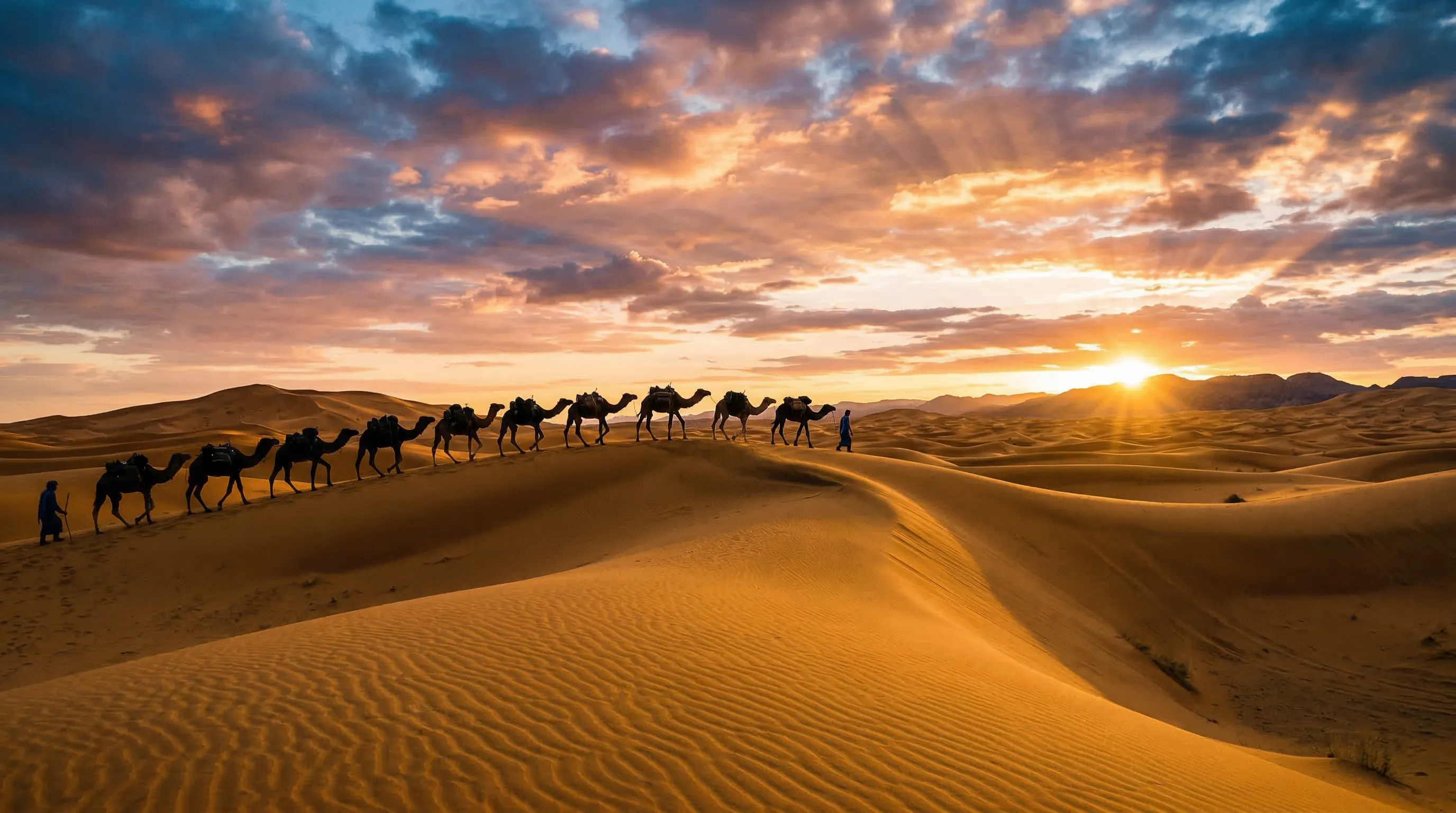
This guide is about the overnight Sahara excursion to Erg Chebbi or Erg Chigaga — a two or three day trip, not a same-day outing. October to April is the golden window. For a year-round desert taste in a single day, the Agafay near Marrakech is the alternative.
In this guide
First, the Sahara is an overnight excursion, not a day trip
It is worth being clear about logistics before talking seasons. The true Moroccan Sahara around Merzouga and M'Hamid is 8 to 9 hours' drive from Marrakech, so a desert camp visit is always a two or three day overnight excursion — you cannot reach the dunes and return in a day. If you only have a single day and still want sand, dunes and a sunset, the Agafay stone desert an hour from Marrakech is the year-round day-trip substitute; this guide covers the seasons for the real overnight desert.
The Sahara around Merzouga and M'Hamid is one of the most extreme seasonal environments on the planet. In December and January, daytime temperatures at Erg Chebbi hover around 15–20°C under brilliant sunshine, while nights drop to 2–5°C — cold enough to need a fleece and hat around the camp fire. In July, the same dunes bake at 45–50°C by midday, and even a short walk in direct sun becomes a physical ordeal.
The best months for the desert overnight: October to April
October through April is when the Sahara overnight is at its most hospitable and most photogenic. Autumn (October–November) brings warm days (25–30°C) and cool nights; the light on the dunes in late October is particularly golden and the summer crowds have cleared. Winter (December–February) is peak season for many experienced travellers: cold nights with blankets and a fire, brilliantly clear skies for star-gazing, and extraordinary dune shadows at sunrise. Spring (March–April) is equally good, with warming days and wildflowers in the scrubland near the camp edges.
- October–November: warm days, cool nights, excellent light, thinning crowds
- December–February: cold nights (2–8°C), clearest skies, fewest tourists, premium atmosphere
- March–April: warming quickly, pleasant days, some wildflowers, still comfortable at night
The shoulder months: May and September
May sees temperatures climbing toward 35°C by midday — still manageable for an overnight excursion with early starts and late-afternoon activity. Many camps run normally and the dunes are quieter than the spring peak. September runs the other way: the worst summer heat has broken but it remains hot (35–40°C at midday), improving dramatically in its second half.
Both months are viable with adjusted expectations. Avoid the middle of the day for outdoor desert activity; sunrise and sunset on the camel trek are still excellent.
When to avoid the overnight desert: June to August
June to August is when many higher-end camps close or dramatically reduce operations. Midday temperatures at Merzouga consistently exceed 42°C, rising to 48–50°C in July. The camel trek becomes a 15-minute dash to the dunes rather than a meditative experience, and sitting outdoors in the afternoon is genuinely dangerous without shade and water. If your dates fall in summer, skip the long overnight run and treat the Agafay near Marrakech as a sunset day trip instead, or head to the cooler High Atlas and Atlantic coast.
- June: warming fast — feasible in early June, uncomfortable by end of month
- July–August: avoid the overnight desert; some camps close — substitute an Agafay sunset day trip
- Heat mitigation: air-cooled tents and generators; all outdoor activity before 9 am and after 5 pm
Erg Chebbi vs Erg Chigaga: does season choice differ?
Both dune fields share similar seasonal patterns. Erg Chigaga (near M'Hamid) sits slightly lower in elevation and can run 1–2°C warmer in summer; its remoteness makes the logistics of a summer overnight even more demanding. In the prime season (October–April), Chigaga's greater isolation from any road or settlement makes for darker skies and quieter dunes — a meaningful advantage for night-sky photography on a two-night excursion.
Frequently asked
Can you do the Sahara as a day trip from Marrakech?
No — Erg Chebbi at Merzouga is 8 to 9 hours' drive each way, so it is always a two or three day overnight excursion. For a same-day desert experience from Marrakech, the Agafay stone desert is about an hour away and runs year-round as a half-day or sunset outing.
What is the best month for the Merzouga desert overnight?
October, November, December and March stand out. December has the coldest nights but the clearest skies and most dramatic atmosphere; October and March balance warmth and comfort for milder desert nights on the overnight trip.
Is the Sahara cold at night?
Yes — significantly. From October to February, desert nights drop to 2–8°C, occasionally lower. Camps supply blankets and many provide fleece jackets, but bring your own warm layer. The cold around the camp fire is part of the overnight experience.
Is the Sahara too hot in summer?
July and August daytime temperatures routinely exceed 45°C, and most operators advise against the overnight desert then. If you travel in summer, request an air-cooled tent and confine activity to before 9 am and after 5 pm — or swap in an Agafay sunset day trip from Marrakech.
Can you see stars in the Moroccan Sahara?
On clear, moonless nights — spectacularly. The best conditions are December to February on a new-moon night at a remote camp away from any generator, which only an overnight excursion delivers. Erg Chigaga, more distant from roads, has marginally less light pollution than Merzouga.
Planning a trip?
Let a Marrakech atelier handle the details.
Tell us your dates and style and we'll send a written itinerary and a transparent quote within 24 hours.
Request an itineraryKeep reading
Planning
Sahara from Marrakech: Why It's an Overnight, Not a Day Trip
Travellers searching for a Sahara day trip from Marrakech soon hit a hard truth: the real dunes are too far to see and return in one day. Here is why Merzouga, Chigaga and Zagora are overnight excursions — and why Agafay is the genuine desert day trip near the city.
Planning
The Best Time to Visit Morocco
Spring (March–May) and autumn (September–November) are the best all-round times to take day trips and short excursions in Morocco — warm but walkable days, cool evenings and the long daylight that lets you squeeze a full Agafay, Ourika or Ait Ben Haddou day out of a single city base.
Itineraries
Morocco Itinerary: 10 Days
Ten days is the sweet spot for an excursion-led Morocco trip — long enough to pair two city bases with a full set of day trips, plus one short overnight to the desert or the coast, without living out of a suitcase.