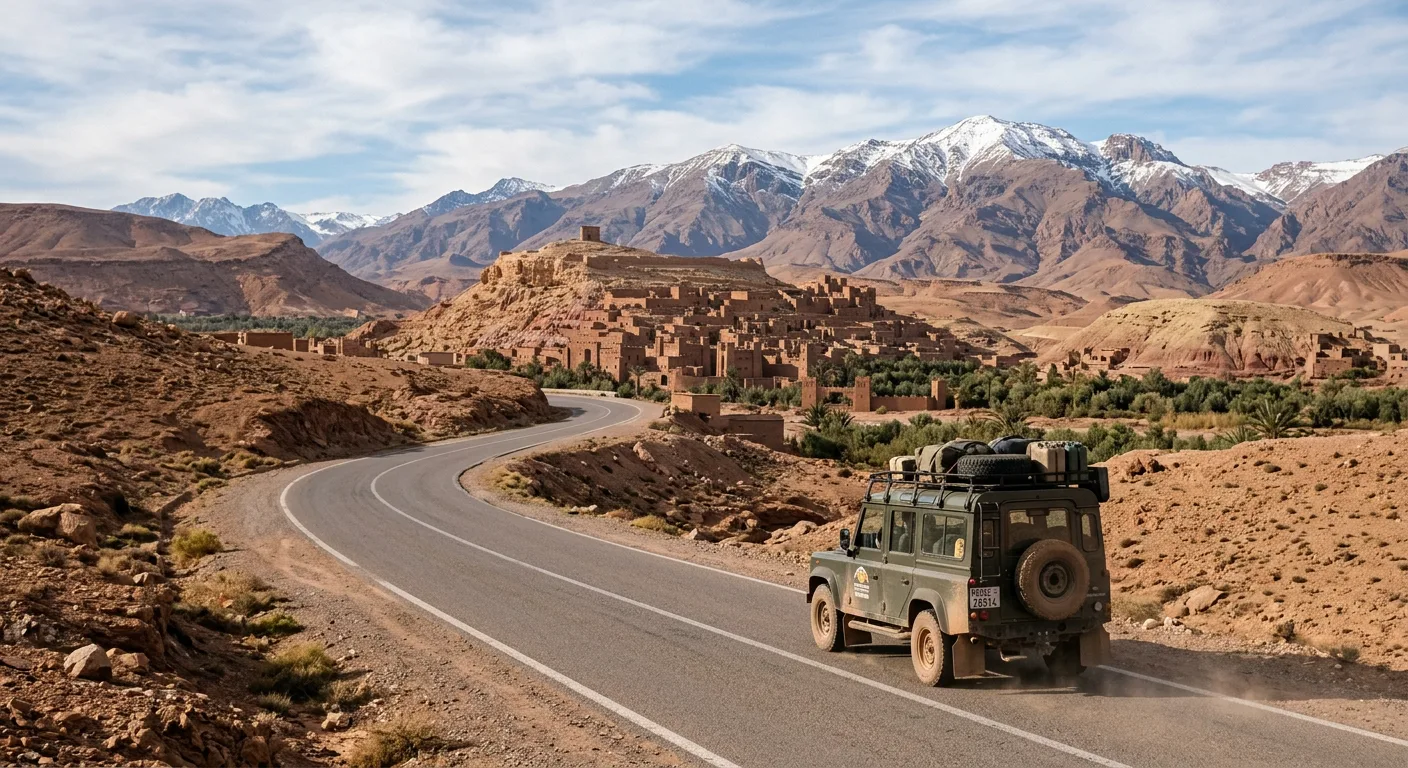
When you only have a few days, every day trip is a round trip — you leave a city base in the morning and you need to be back that evening. That changes how you think about driving. The landscapes on the way to Ouzoud or over the Tizi n'Tichka are extraordinary, but the clock and the road conditions decide whether a destination is realistic in a single day. Here is what we tell day-trippers who ask, honestly, whether to rent a car or take a driver.
What are the day-trip roads actually like?
The motorway network — the autoroutes — connecting Casablanca, Rabat, Fès, Marrakech and Tangier is excellent, but few day trips use it. The routes you will drive are national roads (prefixed N): the N9 climbing the Tizi n'Tichka toward Aït Ben Haddou is paved and spectacular but slow, with endless switchbacks and lorries crawling up the grade. The flat coastal N8 out to Essaouira is the easiest day-trip road in the region. The Ourika and Ouzoud roads narrow as they climb. None of the standard excursions require a piste, but the unpaved Agafay tracks are best left to a driver who runs them daily; we never recommend a standard rental car off the tarmac.
How do checkpoints work on day-trip routes?
Checkpoints (barrages) are a normal feature of the intercity roads day-trippers use, not an anomaly. An officer steps into the road with a baton; you slow and stop. Have your passport, your home licence, and your rental contract in the glove box, ready to hand over. Officers will check your speed — they have radar — and occasionally breathalyse. Morocco has a zero-tolerance drink-driving law: the legal limit is 0.0 g/L. Be courteous, patient and clear, and allow a few minutes of slack in your day for a stop or two. If a fine is issued it is paid in dirhams, on the spot; ask for a receipt (un reçu, s'il vous plaît).
Where do you leave the car at each destination?
Most day-trip destinations have a simple supervised car park where a gardien charges 10–20 MAD — the Ouzoud falls car park above the village, the Aït Ben Haddou lot across the river, the Essaouira ports and ramparts parking. Note that the Marrakech medina itself is car-free, so on a check-out-day trip you park outside the walls and walk in. Riads routinely send someone to meet you and manage luggage at the nearest gate. Factor the walk-in and walk-out at each end into your day, not just the drive.
What does a day-trip rental actually cost?
A small manual (Dacia Sandero category) runs approximately US$25–40 per day from international agencies (Avis, Hertz, Europcar) at Marrakech or Casablanca airports. Local agencies advertise lower rates but their insurance terms and breakdown cover are often inadequate — read the small print carefully. Full collision damage waiver (CDW) and theft protection are worth paying for. Fuel is roughly US$1.20 per litre for petrol; a return day trip to Ouzoud or Aït Ben Haddou will use a meaningful chunk of a tank, so fill up before you leave the city.
Why most day-trippers take a private driver
We are not unbiased — our drivers run these routes for a living. But the reasons people give after trying to self-drive a day trip and then switching are consistent: the Tizi n'Tichka switchbacks were more tiring than expected, they burned daylight finding parking, and they spent the day watching the road instead of the scenery. On a day trip a driver also lets you doze on the long return and arrive back relaxed rather than frazzled. A private driver for the day costs roughly US$90–150 all-in for the popular routes, which across a group of four is modest per person — and you gain someone who knows exactly which viewpoint to stop at on the Tizi n'Tichka and how to time the day to be home before dark. See our guide service for details.
Practical rules if you self-drive a day trip
- Set a firm turnaround time so you clear mountain roads before dark — livestock and unlit mopeds are serious hazards after dusk.
- Download offline maps (Maps.me or Google Maps offline) before you leave — data signal drops out on the Tizi n'Tichka and in the Ourika and Ouzoud valleys.
- Keep a physical copy of your rental contract, insurance, and passport photo page in the car.
- Fill the tank in the city before you go; on the Aït Ben Haddou run, top up again in Ouarzazate for the return.
- Stick to paved roads — leave the Agafay tracks and any piste to a 4x4 with a local driver.
- At a checkpoint: engine off, window down, hands visible on the wheel. Slow and calm.
Frequently asked
For a day trip, should I self-drive or take a private driver?
For a single day out of Marrakech — Ourika, Ouzoud, Aït Ben Haddou over the Tizi n'Tichka — a private driver almost always wins. You skip parking hassles, you can doze on the long return leg, and a driver who runs the route daily knows where to stop and how to time the day so you are home before dark. Self-driving makes more sense for the flat coastal run to Essaouira, where the road is easy and the day is short. If in doubt for the mountain routes, take the driver.
What documents do I need to rent a car for a day excursion?
A valid driving licence from your home country is sufficient for most nationalities — no International Driving Permit is required. Your passport, a credit card in your name, and an age of at least 21 (sometimes 23 for larger vehicles) complete the list. The rental contract and insurance certificate must travel with you in the car, even on a day trip you'll return the same evening.
Will police stop me on a day-trip route?
Quite possibly. Checkpoints — a police officer stepping into the road with a baton — are common on the intercity roads day-trippers use, like the N9 over the Tizi n'Tichka or the road out to Essaouira. Pull over smoothly, wind down the window and have your passport and rental contract ready. Officers usually wave tourists through after a brief check. Build a few minutes of slack into your day for one or two stops.
What is the speed limit in Morocco?
Urban areas: 40–60 km/h. Open roads: 100 km/h. Motorways (autoroutes): 120 km/h. Speed cameras are plentiful and radar guns are used at checkpoints. Fines are paid on the spot in cash dirhams. Moroccan road signs follow European conventions. On winding mountain day-trip roads you'll rarely reach the limit anyway — the bends, not the signs, set your pace.
How long do the popular day trips actually take to drive?
Realistic one-way drive times from Marrakech: Ourika Valley about 1 to 1.5 hours; Agafay roughly 45 minutes; Ouzoud Falls about 2.5 to 3 hours; Essaouira about 2.5 to 3 hours on easy flat road; Aït Ben Haddou about 3.5 to 4 hours over the Tizi n'Tichka pass. Double those for the round trip and you'll see why Aït Ben Haddou and Ouzoud are full long days, while Ourika and Agafay work as half-days.
Can I get back to my city base after dark on a day trip?
Plan not to drive the mountain or rural legs after dark if you're self-driving. Unlit mopeds, livestock on the road, poorly marked speed bumps and fatigue make night driving the biggest risk for visitors. On long days to Aït Ben Haddou or Ouzoud, set a firm turnaround time so you clear the Tizi n'Tichka in daylight — or let a driver take the dark return while you rest.
Skip the road stress
Let a driver handle the day while you enjoy it.
Our drivers run these day-trip routes daily — licensed, English-speaking, and used to timing Ourika, Ouzoud, Essaouira and Aït Ben Haddou so you are back at your base before dark. We can pair a driver with a local guide at the destination for the full picture.