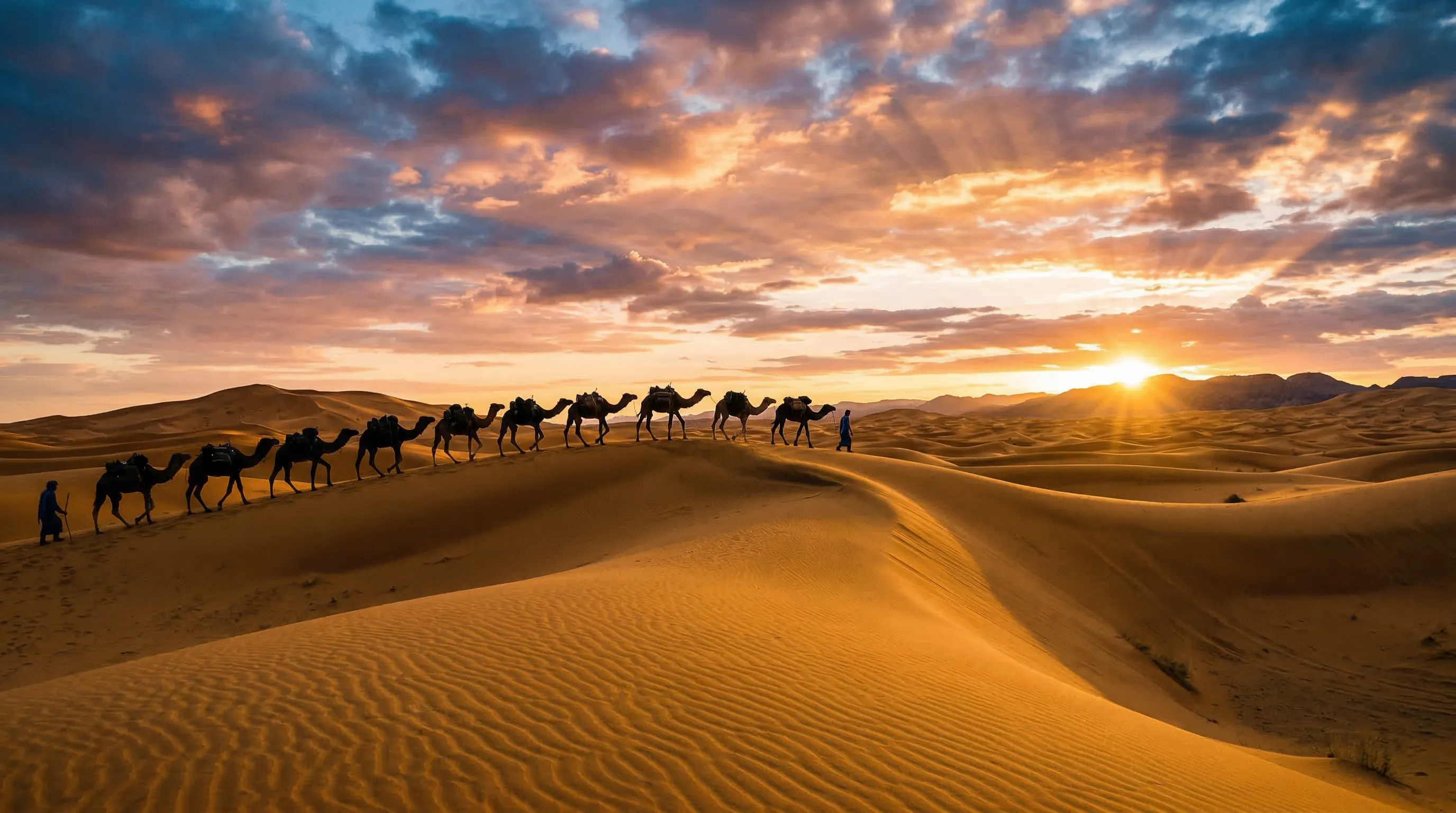
Morocco is a photographer's country in a way few destinations match — landscape, architecture, craft, portraiture and remarkable light, much of it within a short drive of Marrakech. If your trip is built around day excursions rather than a two-week circuit, the trick is knowing which great frames are genuinely reachable and back-by-dark, and which ones need an overnight to do properly. This guide is organised exactly that way, written from years of running these routes for guests and photographers.
Day trip or overnight?
Shootable in a single day from Marrakech: the Ourika Valley, the Ouzoud cascades, the Agafay stone desert at sunset, and — as a long full day — the ksar of Aït Ben Haddou and the ramparts of Essaouira. Needs an overnight: the Sahara sand seas of Erg Chebbi (9–10 hours each way) and Erg Chigaga, and the blue lanes of Chefchaouen in the far north. Plan the sand sea as a 2–3 day trip, not a sunrise dash.
Agafay — the desert you can shoot and be home by night
The Agafay stone desert, roughly 40 minutes southwest of Marrakech, is the photographer's answer to "I want desert but I only have a day." It is not the orange sand sea of the postcards — it is a rolling, mineral, lunar landscape — but in the last hour of light it is genuinely cinematic: long shadows raking across bare ridges, the High Atlas often snow-capped on the horizon, and camp lanterns coming on at dusk. Arrive ninety minutes before sunset, shoot the golden hour, stay for the blue hour, and you are back in the city for dinner.
A 24–70mm handles most of it; a wide-angle exaggerates the empty foreground and big sky, while a 70–200mm pulls the Atlas backdrop in tight behind a lone camel or rider. For the real Sahara dunes — Erg Chebbi and Erg Chigaga, far to the southeast — budget an overnight; they cannot be reached and shot in a day from Marrakech, whatever a tour listing implies.
The Ourika Valley — rivers, terraces and Berber villages
The Ourika Valley, about an hour south of Marrakech, is the easiest half-day landscape shoot in the region. The road follows a fast green river past terraced gardens and flat-roofed Berber villages climbing the valley sides, with the High Atlas rising behind. The Setti Fatma waterfalls at the valley head are a short scramble worth doing — best in late morning when light reaches the canyon floor. A polarising filter is invaluable here to cut glare off the water and saturate the river greens.
Spring is the strongest season — running water, blossom in the lower villages and crisp air. Stop at a riverside terrace for mint tea and you will usually find willing portrait subjects among the families who run them; ask first, engage first, and the frames come naturally. The whole valley is a comfortable single-day excursion.
Ouzoud — Morocco's most photogenic waterfalls
The Ouzoud cascades, around two and a half hours northeast of Marrakech, drop over 100 metres in tiered falls and are one of the country's best single-day photo destinations. The classic frame is from the lower viewpoints looking up through the spray, ideally in the late morning when sun angles into the gorge and throws rainbows across the mist. The resident Barbary macaques in the surrounding oak woods are a bonus subject for a telephoto.
Bring a polariser to manage spray glare and, if you carry one, a small tripod and ND filter for silky long-exposure water. The falls run fullest from late winter through spring. It is a long but very doable day trip — leave Marrakech early and you have the gorge before the bulk of the crowds arrive.
Aït Ben Haddou — the great earthen ksar in a day
The route south from Marrakech over the Tizi n'Tichka pass (2,260 metres) is a landscape corridor in its own right — stark, mineral heights giving way to the pink-red earth of the Ouarzazate plateau. The payoff is the Aït Ben Haddou ksar, a UNESCO World Heritage site of fortified earthen towers (a ksar is a fortified village) that glows against the late-afternoon sun. It is a long full day from Marrakech — realistic, but only if you commit to an early start and accept a late return.
Shoot it from across the riverbed for the classic elevation of stacked towers, then climb up through the ksar for detail frames of the mud-brick texture and carved doorways. A 24mm wide-angle captures the whole hillside; a telephoto isolates single towers against the sky. If you want to continue into the Draa Valley palmeries and kasbahs beyond, that is where a single day runs out and an overnight earns its place.
Photographing people: how to do it well and respectfully
On a day excursion your best portraits come from people you actually meet — village families in the Ourika, terrace-café owners, argan-oil cooperative workers, the guides who run the Agafay camps. The rules are simple but worth stating plainly:
- Always ask before photographing someone at close range. A gesture and eye contact communicates the question. Respect a refusal without negotiation or payment pressure.
- Engaging with what someone is doing — asking about the work, buying something at a roadside stall — almost always produces a natural willingness to be photographed. Make it social, not transactional.
- Street photography at medium distance (70–135mm) is standard and generally accepted. Pointing a wide-angle into someone's face is not.
- Show people their image on the camera screen. The reaction is almost always positive and often opens a longer conversation.
- At busy spots back in Marrakech — the Jemaa el-Fna square, the snake charmers, the henna artists — a small payment for photographs is expected and fair; agree a figure (10–20 MAD) before you shoot.
Our day-trip planners can build in a cooperative or village stop where people have agreed to photography in advance — the difference in image quality from a relaxed, consenting subject is enormous. See our local guides and photography-friendly excursions.
Frequently asked
What can I actually photograph on a single-day excursion from Marrakech?
Plenty. Within day-trip range you can shoot the Ourika Valley and its waterfalls, the cascades and rock pools of Ouzoud, the lunar Agafay stone desert at sunset, and the famous earthen ksar of Aït Ben Haddou (a long but doable full day). The Atlantic ramparts of Essaouira also work as a long single day. What does not fit a day are the Sahara sand seas of Erg Chebbi and Erg Chigaga — those need an overnight, so plan accordingly.
What is the best time of year to photograph day trips around Marrakech?
October–November and March–April give the most consistent light — warm, directional and free of summer haze. Spring greens up the Ourika and Atlas valleys; Ouzoud's falls run fullest from late winter through spring. Summer light is harsh between 10am and 4pm, but Agafay sunsets stay reliable year-round. Aim to be on location for the first or last hour of light — easy on a day trip if you leave the city early.
Is it acceptable to photograph people on these excursions?
Always ask first, especially for close-up portraits. Many Moroccans — particularly in the rural Ourika and Atlas villages — are uncomfortable being photographed without consent. A gesture and a questioning look usually conveys the request; respect a refusal without negotiation. At market stalls and roadside cooperatives, photographing people at work is generally welcomed if you engage with what they're doing first.
What camera gear suits a Morocco day trip?
A versatile 24–70mm or 24–105mm covers most of what a day excursion throws at you — valleys, waterfalls, kasbahs, portraits. A wide-angle (16–24mm) helps with the Agafay horizon and the towers of Aït Ben Haddou. A telephoto (70–200mm) compresses the Atlas backdrop and lets you keep a respectful distance for candid shots. A polarising filter cuts glare off the Ourika river and Ouzoud spray. Pack light — you're moving all day.
Can I photograph inside Moroccan mosques on a day trip?
Non-Muslims cannot enter the interior of active mosques in Morocco, the exception being the Hassan II Mosque in Casablanca, which runs organised tours with photography allowed in set areas. Exterior photography is always fine — and on excursions the doors, minarets and tiled courtyard walls of village mosques visible from the street make strong architectural subjects without entering at all.
Which day trips are best for photographing Moroccan craft and rural life?
The argan cooperatives on the Essaouira and Ourika roads, the Berber villages of the Ourika and Imlil valleys, and the roadside potters near the Ourzazate route all reward a stop. Aït Ben Haddou's restored ksar is a set-piece in late-afternoon light. Ask your day-trip planner to flag a cooperative or village visit in advance — people who have agreed beforehand are far more relaxed and give better photographs.
Photography day trips
We build excursions around the light, not the tour schedule.
Golden hour at Agafay, late light on Aït Ben Haddou, the Ourika river before the crowds — tell us what you want to shoot and how many days you have, and our planners route around the light.
Request an itinerary