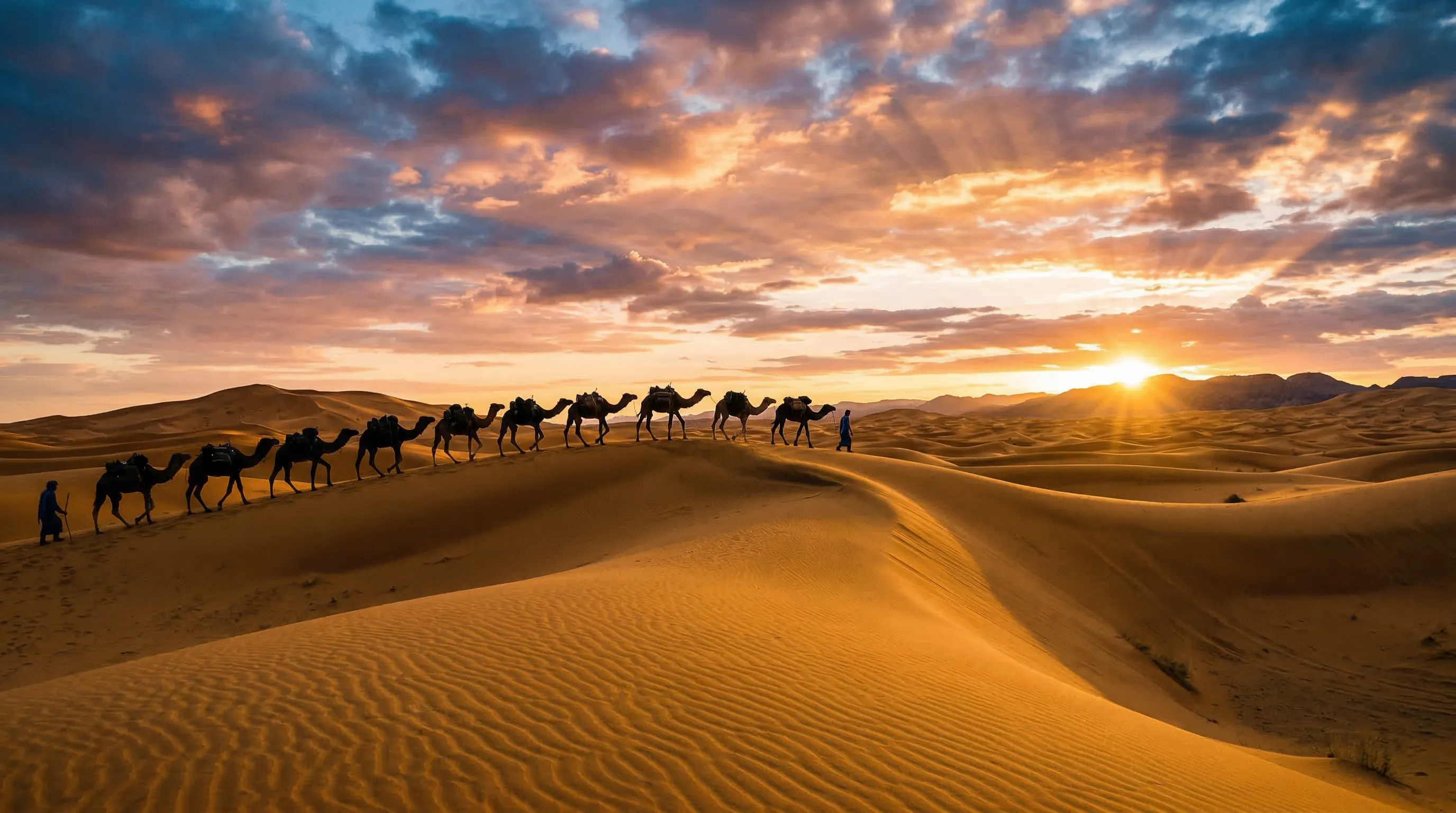
A night in the Moroccan Sahara is one of the experiences people describe for decades afterwards. The dunes at sunset, the silence after midnight, a sky so unpolluted you can pick out the Andromeda galaxy with the naked eye. But before you fall for the brochure photo, the honest part: the real sand-sea camps are a long way from the cities. "Desert camp" also covers a spectrum from a shared tent on a rope cot to a freestanding pavilion with a king bed, outdoor shower and private terrace. This guide explains both the distances and the differences plainly, so you can choose without surprises.
Read this first if your days are limited
A genuine night at Erg Chebbi or Erg Chigaga is a two- to three-day trip from Marrakech — Merzouga is 9–10 hours each way, the M'Hamid ergs about seven plus piste. None of it is a day trip. If you have a single free day and want desert atmosphere, the realistic option is an Agafay stone-desert camp, roughly 40 minutes from the city: sunset dinner, camels, stars, home by night. The sections below describe the real Sahara so you know exactly what the longer journey buys you.
Erg Chebbi (Merzouga) vs Erg Chigaga (M'Hamid)
Morocco has two main ergs — seas of sand dunes — that host overnight camps. Erg Chebbi, near the village of Merzouga in the Tafilalet region, is the one you have seen in photographs: a concentrated mass of orange dunes rising to 150 m, with camps clustered at the edge of the desert within a short camel or quad ride. It is more accessible (tarmac road to the doorstep), better served by flights via Errachidia, and has the widest range of camp operators from budget to ultra-luxury.
Erg Chigaga, roughly 50 km east of M'Hamid el-Ghizlane near Zagora, is Morocco's largest erg and significantly more remote. The last two hours require a 4×4 on piste; most visitors add a camel or quad leg to reach their camp. The reward is near total silence and a fraction of the visitor numbers. We route clients who have already visited Erg Chebbi, or those for whom solitude is the primary goal, through Erg Chigaga. Browse our Sahara destination pages for more context on both ergs.
Standard camps
Standard desert camps — the majority operating at Erg Chebbi — use large canvas or Moroccan-style haima tents with simple iron or wooden bed frames, basic cotton bedding and a shared toilet and cold shower block for every four to eight tents. Dinner is a communal tagine or couscous served in a central marquee. Price range: US$40–80 per person including dinner, breakfast and a sunset camel ride.
The experience is genuine and often memorable, but the variables are high — tent condition, food quality and plumbing reliability vary considerably between operators. If you arrange it independently, read reviews from the last three months. If you go through our day-trip planners, every camp we put forward has been checked by drivers who work this region year-round.
Luxury and boutique camps
Luxury camps have transformed considerably over the past decade. The best now offer freestanding private tents of 30–50 m² with proper king-size beds (not cots), en-suite or adjacent private bathrooms with hot showers and flush toilets, terrace seating and in some cases a private plunge pool. Décor ranges from Bedouin minimalism to full Moroccan riad aesthetic transported to the dunes.
Dinner at a good luxury camp is a proper multi-course meal — harira soup, pastilla, slow-cooked mechoui lamb, Moroccan sweets — served at a set table with candles rather than from a central buffet. A house musician typically plays after dinner. Price range: US$200–600+ per person, depending on the camp, season and level of exclusivity. Some of the most remote camps at Erg Chigaga position themselves as all-inclusive lodges and price accordingly.
What a night actually includes
For any reputable camp, standard inclusions are:
- Transfer from the village or road to the camp — camel, 4×4, quad or a combination, usually 20–60 minutes.
- Sunset dune experience — most camps position guests on a nearby dune crest for the hour before dark.
- Dinner — communal or private depending on camp tier.
- Accommodation — the tent itself; quality varies significantly.
- Breakfast — bread, honey, olive oil, coffee, mint tea.
- Morning camel or 4×4 return to the road or village.
Not always included: alcoholic beverages (Morocco is Muslim — some camps supply wine on request, others do not), dune boarding or quad bikes (usually charged separately), stargazing with a telescope (a genuine add-on at several good camps), and laundry.
Drive times — and why this is never a day trip
Marrakech to Merzouga (Erg Chebbi): about 560 km via Tizi n'Tichka and Ouarzazate, 8–9 hours each way. That distance is the whole reason a real Sahara night cannot be a day trip. The sensible approach splits it over two days, with a stop in Ouarzazate or the Dades Gorges, turning the drive into part of the trip rather than an endurance test — three days return, realistically.
Fès to Merzouga: about 360 km via Midelt and Errachidia, 5–6 hours — doable in one long day if you leave early. Travellers crossing the country often run a Marrakech–Fès circuit with the Sahara in the middle, which spreads the driving across several days.
Marrakech to M'Hamid (Erg Chigaga): about 530 km via Ouarzazate and Zagora, 7–8 hours to M'Hamid, plus 2 hours of 4×4 piste to the erg. A serious journey that needs at least two nights set aside for the desert. If that is more than your trip allows, the Agafay camp 40 minutes from Marrakech is the one-day stand-in — not sand-sea Sahara, but a real desert night within reach. See our short excursions and longer desert routes for both options.
When to go and what to pack
The prime windows are October–November and February–April. December and January are cold (lows near 5 °C or below) but offer extraordinary solitude. July and August are punishing — 40 °C+ in the afternoon, though the nights are pleasant.
Essential packing regardless of season: a mid-weight fleece or down layer for evenings, a headtorch, sunscreen, lip balm (the air is very dry), a shemagh or scarf for sandstorms, and a power bank (most camps have limited charging). Sand gets into everything — protect camera gear in a sealed bag.
Frequently asked
Can I see a Sahara desert camp on a day trip from Marrakech?
Not the real sand-sea camps at Erg Chebbi or Erg Chigaga — those are 9–10 and 7+ hours away by road, so a genuine night there is a 2–3 day trip minimum. What you can do in a single day is the Agafay stone desert, about 40 minutes from Marrakech, where camp-style dinners, sunset and camel rides run as a half-day or full-day excursion. This guide explains the true Sahara camps so you know what you're trading off when days are short.
What is the difference between Erg Chebbi and Erg Chigaga?
Erg Chebbi near Merzouga is the larger and more accessible of the two — tarmac to within a short camel ride of the main dunes, with camps from budget to ultra-luxury. Erg Chigaga near M'Hamid is more remote (around 2 hours of piste from the nearest road), broader in total area, and far quieter; reaching it usually means a 4×4 transfer or a longer camel or quad leg. Both are overnight expeditions from Marrakech, not day excursions.
How long does it really take to drive from Marrakech to Merzouga?
Around 560 km via the Tizi n'Tichka pass and Ouarzazate — 8–9 hours on a good day, each way. That is why no honest operator sells it as a day trip. The drivers who run this route daily break the journey overnight in Ouarzazate or the Dades Gorges, making the round trip three days. Some travellers fly Casablanca–Errachidia to save a day each direction.
What is typically included in a desert camp night?
A well-run camp includes a private or semi-private tent with proper beds and bedding (not roll mats), en-suite or private toilet and shower, dinner (a multi-course Moroccan meal with tagine, couscous or mechoui), breakfast, a sunset camel or 4×4 excursion to a dune crest, and music around a fire. Some add stargazing, guided morning dune walks and quad options. An Agafay camp near Marrakech offers a lighter version of the same evening within day-trip reach.
Is it cold in the Sahara at night?
Yes — more than most visitors expect. Desert temperatures swing sharply between day and night. In October and March, overnight lows can drop to 5–8 °C; December through February can see frost. July and August nights are warm (20–25 °C) but daytime heat (40 °C+) makes summer demanding. Pack a fleece regardless of the month — the same advice holds for an Agafay night.
When is the best time to visit the Sahara in Morocco?
October–November and February–April are the prime windows — days pleasantly warm (22–30 °C), nights cool but not freezing, and the dune light extraordinary. December and January are colder but offer the fewest visitors and even occasional snow-dusted crests, a rare sight. Avoid July and August unless you actively want extreme heat. The same season suits short Agafay excursions from Marrakech.
Ready to sleep under the stars?
We'll tell you honestly which desert your days allow.
Every Morocco Day Trips desert run is fully private — private vehicle, a driver who runs the route regularly, and a camp checked on the ground. One day means Agafay; two or three opens the true Sahara. We won't pad a coach window and call it a desert.
Plan a Sahara journey