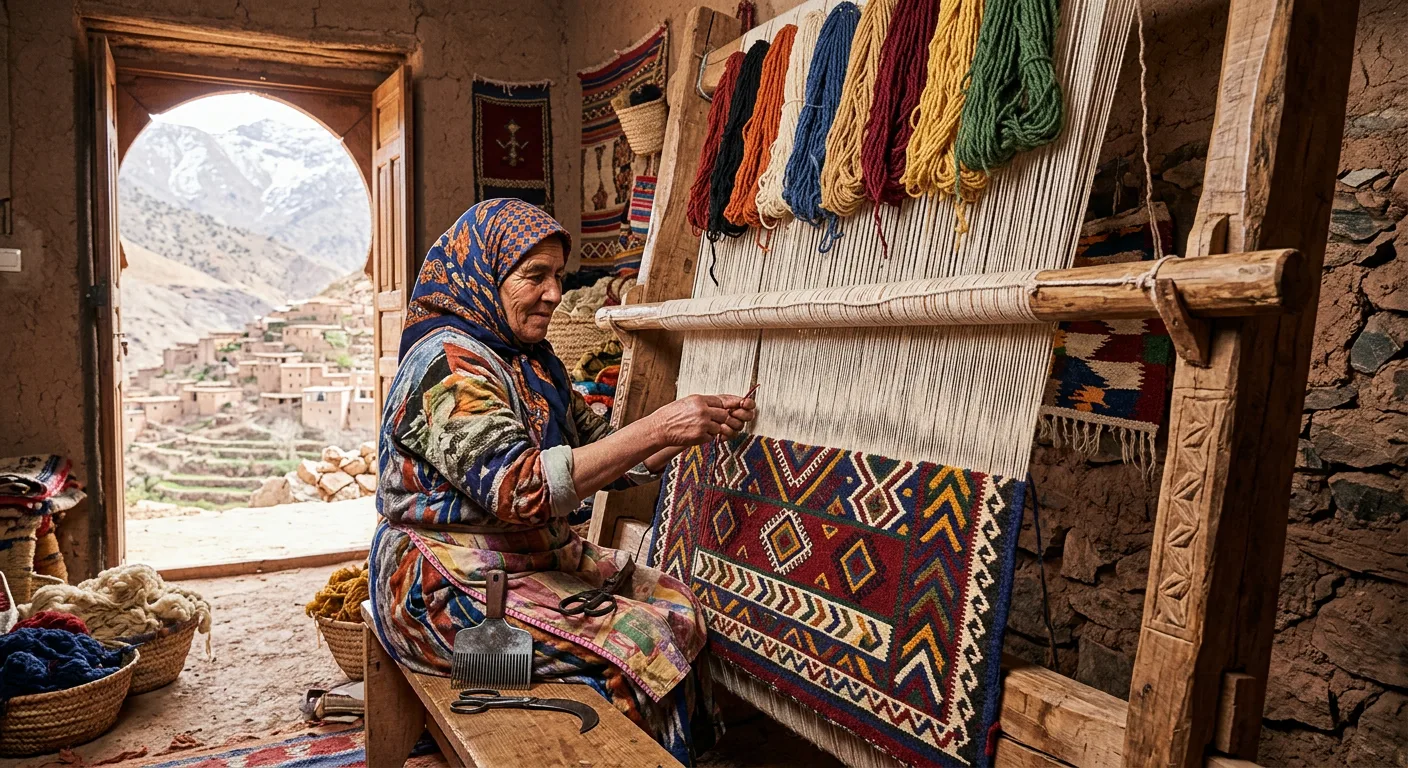
Some of the best Moroccan crafts are bought not in a city souk but at the roadside stops your day trips already pass: argan co-ops on the Essaouira and Agadir road, carpet and pottery stops on Ourika and Atlas days, thuya wood in Essaouira. Here is what to buy where your excursions take you — and how to spot the real thing.
In this guide
What can you buy on the excursion routes themselves?
Many day trips pass the very places where Morocco's crafts are made, which means the souvenir hunt can happen en route rather than only in the city. The classic example is the Essaouira and Agadir road, lined with women's argan co-operatives where you can watch the nuts being cracked and pressed and buy oil at the source — a natural stop on an Essaouira day trip from Marrakech. Atlas and Ourika Valley days often include a Berber carpet stop or a roadside pottery, where rugs come straight from the village looms. And Essaouira itself is the only place in the country for thuya wood marquetry, made in the workshops behind the sea ramparts you walk on a coastal day.
These on-route purchases carry something a city shop cannot: provenance you have seen with your own eyes. The trade-off is that organised group tours sometimes build in commission stops, so it pays to know a fair price and a genuine product before you are ushered inside. The most rewarding souvenirs everywhere are the made-by-hand ones — a hand-knotted rug, vegetable-tanned Fes leather, cold-pressed argan oil, a thuya box — not the mass-produced trinkets near the big sights.
- Argan oil: at a women's co-op on the Essaouira/Agadir road — culinary (toasted, nutty) or cosmetic (golden, mild).
- Hand-knotted Berber rugs (Beni Ourain, Boucherouite, Azilal): from carpet stops on Ourika and Atlas day trips.
- Thuya wood: fragrant marquetry boxes, chess sets and frames — Essaouira only, on a coastal day.
- Leather goods from Fes: babouche slippers, bags, poufs — best bought in the Fes medina itself.
- Ceramics: blue-on-white Fassi pottery; polychrome Meknes ware; terracotta Safi pots.
- Spices: ras el hanout, Taliouine saffron, Dadès rose petals — from the city souk by weight.
Where does each craft belong — route stop or city souk?
Some crafts are best bought on the road, others back in the medina, and knowing which saves both money and disappointment. Argan oil belongs to the route: the certified women's co-operatives along the Agadir–Essaouira road are the authentic source, and buying directly ensures the women receive the income rather than a middleman — a far better purchase than a tourist-souk bottle. Rugs split both ways: the carpet stops on Atlas and Ourika days bring you closer to the village weavers, while Marrakech's souk des tapis offers the widest choice if you would rather compare many in one place. Thuya wood is route-specific in the purest sense — it exists only in Essaouira.
City souks remain the best bet for crafts not tied to a particular road. Fes is the capital of leather and fine ceramics — the Chouara tannery workshops and the Ain Nokbi pottery quarter sell at workshop prices. Marrakech's Rahba Lakdima is the place for spices and herbs bought loose by weight, and the lantern souk for hand-pierced brass. The rule of thumb: buy argan and rugs where your excursion passes their source, and buy spices, leather and lanterns in the medina where the choice is widest.
- On the route: argan oil (Essaouira/Agadir road co-ops); thuya wood (Essaouira only); roadside carpets on Atlas/Ourika days.
- Rugs, either way: route carpet stops for provenance, or Marrakech souk des tapis for the widest choice.
- City souk: Fes leather (Chouara tannery shops) and Fassi ceramics (Ain Nokbi pottery quarter).
- City souk: Marrakech Rahba Lakdima for ras el hanout, dried herbs and rose petals by weight.
- City souk: Marrakech lantern souk for hand-pierced brass and copper lamps.
How do you know if a roadside or souk souvenir is authentic?
Whether you are at a carpet stop on an Atlas day or in the Marrakech souk, the same shelf can hold a genuine hand-knotted Berber rug and a machine-woven copy, a real argan oil and an adulterated one, a true Essaouira thuya box and a factory imitation. A few practical checks cut through it.
For rugs, turn them over: hand-knotted rugs show irregular, tight individual knots on the reverse, while machine-made ones have a smooth, fabric-like backing; natural wool feels springy and warm, synthetic fibres cooler and faintly plasticky. For argan oil, genuine cold-pressed cosmetic oil is golden-amber with a mild, nutty scent and a fluid texture — adulterated versions are cheaper, paler and sometimes faintly synthetic in smell, which is exactly why buying at a working co-op on the route matters. For ceramics, look for hand-painted decoration with slight brush-stroke irregularities rather than uniform transfer prints.
Which souvenirs travel home easily from a day trip?
Buying on a day trip means carrying it home, so weight and fragility matter. The most transportable items are spices and food products (ras el hanout, argan oil, honey, preserved lemons, rose water), small ceramics like a hand-painted tea glass or spice bowl, lightweight babouche slippers, and Moroccan tea glasses with their ornate holders. These slip into a standard bag and arrive intact.
Bigger buys need planning. A hand-pierced brass lantern packs only if you wrap it in clothing; a small boucherouite rug rolls tight enough for cabin luggage, while a larger carpet is best shipped — most rug sellers, including those at route carpet stops, arrange international shipping. One firm rule: argan oil over 100 ml cannot go in carry-on, so pack it in hold luggage or have it shipped. And never buy anything made from tortoiseshell, ivory or protected animal materials — customs seizure is a real risk and the purchase is indefensible.
- Best to carry: spices, argan oil (in hold luggage), tea glasses, babouche slippers — all light.
- Best to ship: large rugs, big lanterns, ceramic sets — route carpet stops and souk shops both ship internationally.
- Argan oil rule: over 100 ml is confiscated at security; pack in checked luggage or ship.
- Never buy: tortoiseshell, ivory or protected animal products — illegal to import in most countries.
What should you pay, on the route or in the souk?
In open souks and at unmarked route stops, opening prices typically run 200–400% of a fair figure and bargaining is expected: counter at around 30–40% of the asking price and aim to settle near 50–60% of the original. The reassuring exceptions are the women's argan co-operatives, which work on transparent fixed prices, and any shop advertising prix fixe — both remove the haggle and often pass tighter quality control. On a guided day trip, remember the driver or guide may earn commission at a stop, so a polite, unhurried no is always fine.
The single most effective tactic anywhere is to walk away slowly and genuinely; a large share of souk sales close when the merchant calls a departing buyer back. If you truly want the piece, return after twenty minutes and the price will usually have moved. On the road, you can also simply note the item and buy it elsewhere — knowing you are not trapped is itself the best negotiating position.
Frequently asked
Where can I buy argan oil on a day trip?
At a certified women's co-operative on the Essaouira–Agadir road, which most Essaouira day trips from Marrakech pass. You can watch the nuts being cracked and pressed and buy at the source. Co-ops use fixed, fair prices and the income supports the women who produce the oil, making it far better than a tourist-souk bottle.
Are the carpet and argan stops on Morocco day tours worth it?
They can be genuinely good — you see the craft being made and buy with provenance — but organised tours sometimes build in commission stops. Go in knowing a fair price, check the rug's reverse for hand-knotting and the argan oil's colour and scent, and feel free to look without buying. The best stops are working co-ops and village looms, not pure showrooms.
Where is the best place to buy a Moroccan rug?
Two good options: the carpet stops on Atlas and Ourika day trips bring you close to the village weavers, while Marrakech's souk des tapis offers the widest choice in one place. For specific Berber styles like Beni Ourain or Azilal, look for co-operatives in the Atlas foothills or shops near Aït Ben Haddou. Always check the reverse to confirm hand-knotting.
Where do I buy thuya wood in Morocco?
Only in Essaouira — the marquetry craft is specific to this coastal town, and the workshops behind the Skala de la Ville sea ramparts are the source. It is one of the best reasons to add an Essaouira day trip from Marrakech: a fragrant box, chess set or frame you cannot buy authentically anywhere else in the country.
Can you bring Moroccan souvenirs through customs?
Standard crafts — ceramics, leather, textiles, argan oil, spices — are freely importable in most countries. Argan oil over 100 ml must go in hold luggage, not carry-on. Antiques over 100 years old need Moroccan export paperwork; any genuine-antique seller should provide it. Avoid all animal-product items, which are illegal to import.
Planning a trip?
Let a Marrakech atelier handle the details.
Tell us your dates and style and we'll send a written itinerary and a transparent quote within 24 hours.
Request an itineraryKeep reading
Culture
Shopping on Day Trips: Co-op Stops, Souk Visits & Bargaining on the Road
Some of the best buying in Morocco happens on excursions, not just in city souks — argan co-ops on the Essaouira road, carpet stops on the Ourika and Atlas days, silver in the walled towns. This guide covers what to buy where on a day trip, fair prices, and how to bargain when the clock and the driver are waiting.
Culture
Morocco Etiquette & Customs
A little cultural awareness goes a long way on a Morocco excursion — where you pass through Berber villages, argan co-ops and small shrines that see fewer tourists than the city. Dress modestly, greet warmly, ask before photographing people, use your right hand, and embrace the unhurried pace of mint tea.
Planning
Marrakech as a Base: The Best Day Trips from the City
Marrakech is the perfect base for short trips: a vibrant medina to come home to each evening and an extraordinary range of excursions within an easy drive. Spend a day on the sights and the square, then use the city as a launchpad for Agafay, Ourika, Ouzoud, Imlil, Essaouira and Ait Ben Haddou.