Some of the best buying in Morocco happens on excursions, not just in city souks — argan co-ops on the Essaouira road, carpet stops on the Ourika and Atlas days, silver in the walled towns. This guide covers what to buy where on a day trip, fair prices, and how to bargain when the clock and the driver are waiting.
In this guide
What can you buy on a day trip versus in the city souk?
Day trips and city souks each have their own shopping. On the road, the standout buys are the things made where you stop: cold-pressed argan oil at the women's co-ops along the Essaouira and Agadir roads, Berber rugs at the weaving stops on Ourika Valley and Atlas days, and silver in the walled-town souks of Tiznit and Taroudant. In the cities — Marrakech for lanterns and rugs, Fes for leather and ceramics — you get the widest range but also the hardest bargaining and the most tourist-grade stock mixed in.
A few categories are worth knowing wherever you buy. The same street, or the same roadside stall, can sell a machine-made import and a hand-knotted masterpiece within 10 metres of each other, so the test is always the object, not the location.
- Argan oil (co-op stops): genuine cold-pressed oil from certified women's co-ops on the Essaouira/Agadir roads — the Sous Valley is the source. Culinary oil is toasted and nutty; cosmetic oil is golden and mild. Buying at the co-op is cheaper and more reliable than the souk.
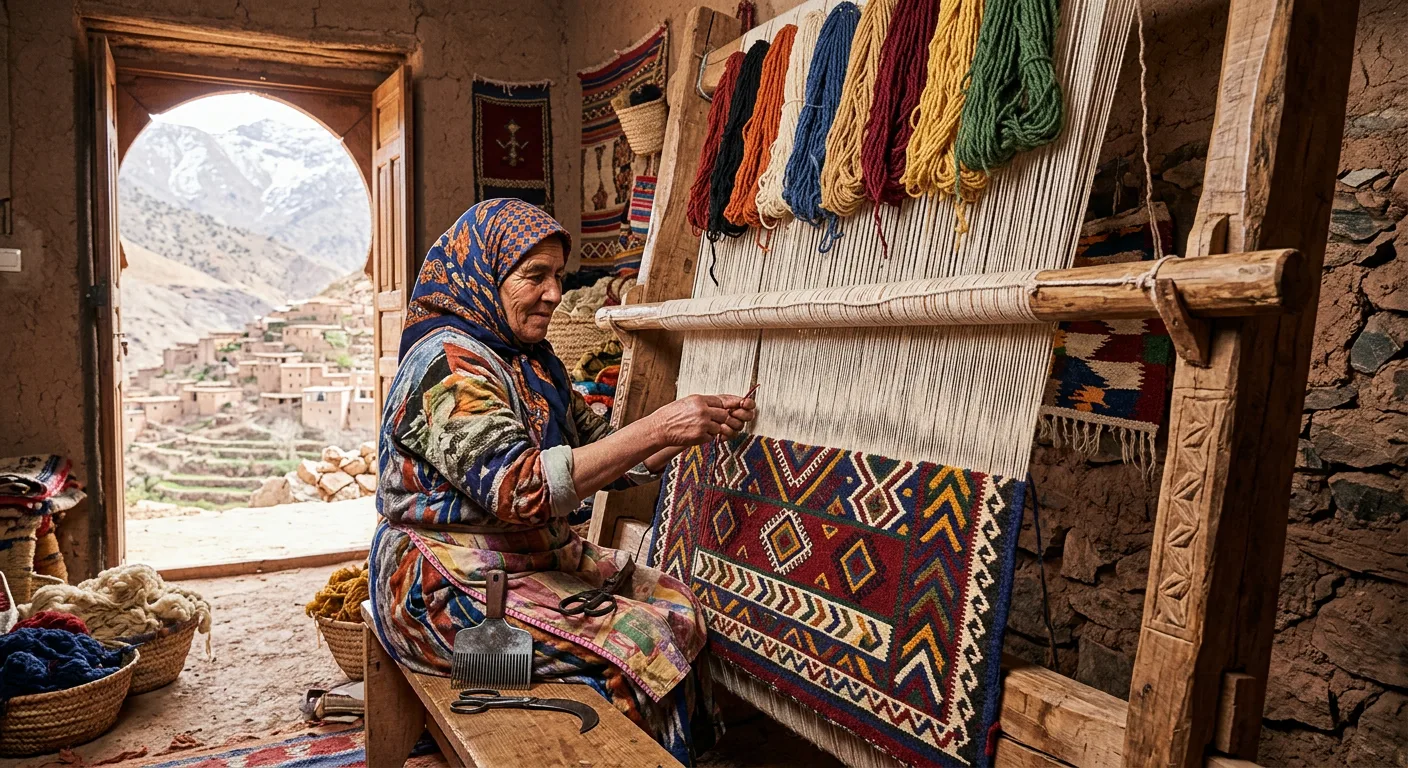
- Rugs and kilims (Ourika/Atlas weaving stops): handwoven Berber rugs (Beni Ourain, Boucherouite, Azilal). Check the reverse for tight, even knots and wool with a slight spring, not a plastic sheen.
- Silver and jewellery (Tiznit, Taroudant day trips): the southern walled towns have a strong silver tradition — a better buy on a day trip than in the Marrakech tourist lanes.
- Leather (Fes day or city souk): Fes is the world capital of vegetable-tanned leather — babouches, bags, poufs. Quality leather is supple and smells natural.
- Ceramics and lanterns (city souks): Fassi blue-and-white pottery and hand-pierced Marrakech brass lanterns. Look for even glazing, clean rims and heavier metal.
What are fair prices at co-op stops and in the souks?
Pricing depends heavily on where you are buying. Roadside co-ops and many artisan stops on organised excursions are effectively fixed-price — the marked figure is close to fair and bargaining is light, which is part of why buying on a day trip is less stressful than a city souk. In the tourist souks, opening prices typically run 200–400% of the local price; open your counter at 30–40% and settle around 50–60% for most goods.
Specific benchmarks (MAD, mid-2026): a 100 ml bottle of quality cosmetic argan oil at a co-op is roughly 80–120 (souk prices for inferior product run 200–500); a pair of babouche slippers, 50–120 fair (quoted 300–500); a small ceramic bowl, 40–80 (quoted 200–400); a medium hand-knotted rug, 1,500–5,000 depending on size, weave and age (opening prices of 8,000–15,000 are common at city carpet stops, including the ones tours visit).
How do you bargain on the road when the driver is waiting?
Bargaining on an excursion has a particular challenge: time pressure. A carpet or argan stop on a day trip is often on the group or driver's schedule, and merchants know you cannot linger or come back tomorrow. The defence is to decide before you walk in what the item is worth to you, name a figure quickly, and not let the tea and the unrolling of twenty rugs commit you. The tea is hospitality, not an obligation to buy.
Walking away still works, even on a tight schedule — telling your driver you are done and heading to the vehicle frequently produces a better last price than anything said inside the shop. On a private day trip you control the clock, so you can take your time or skip a stop entirely; on a group tour you cannot, so go in with a firm number. Be wary of commission-driven carpet and argan stops that are not on your planned route: a polite I'm just looking is enough.
Can you ship day-trip and souk purchases home?
Yes, and for bulky items bought on the road — a rug from an Atlas weaving stop, a crate of ceramics — shipping is often more practical than airline luggage. Most rug and ceramics sellers used to international buyers will roll, bag or crate the piece and send it by DHL, UPS or Moroccan post. Expect roughly US$80–200 for a medium rug to Europe or the US, plus a packing fee (typically 50–150 MAD). Get the seller to write a receipt describing the weave, age and origin — useful for customs and insurance.
Argan oil bought at a co-op needs planning: quantities above 100 ml will be taken at airport security from carry-on, so pack it in hold luggage or have it shipped. For genuinely valuable antique rugs, insist on a signed description; avoid anything in ivory or tortoiseshell entirely. For standard modern crafts picked up on a day trip, shipping is routine and the seller handles the paperwork.
- Rugs (weaving-stop or souk): get a written receipt with weave, age and origin for customs.
- Ceramics: bubble wrap is everywhere; let a specialist crate and ship rather than risk luggage.
- Argan oil from a co-op: over 100 ml goes in hold luggage or ships — security removes it from carry-on.
- Leather: no import restrictions; recondition it on arrival if it dried out in transit.
Frequently asked
Is it better to buy argan oil at a co-op on a day trip or in the souk?
At a co-op on a day trip. The roadside women's co-ops between Marrakech and Essaouira, and along the Agadir roads, sell genuine cold-pressed oil at near-fixed prices (about MAD 80–120 per 100 ml) and let you watch it being made. Souk argan oil varies wildly and is often diluted or not cold-pressed, and costs more for worse product.
Should I buy a rug at the carpet stop on my tour?
You can, but treat it like any souk: opening prices at the carpet stops tours visit are often 8,000–15,000 MAD for a medium rug worth 1,500–5,000. Decide your number before the tea arrives, and remember the driver waiting outside is a negotiating tool, not just pressure. If the stop feels purely commission-driven and off your route, you are free to just look.
How do you know if a Moroccan rug is authentic at a roadside stop?
Turn it over. Hand-knotted rugs show individual, slightly irregular knots on the reverse; machine-made ones have a smooth, fabric-like backing. Natural wool has a faint springiness and warmth, while synthetic fibre feels cool and slightly plasticky. A genuine weaving co-op will happily let you check the back.
Is bargaining expected at co-op and excursion stops?
Less so than in city souks. Certified co-ops and many organised artisan stops are effectively fixed-price, which is part of their appeal on a day trip. In the walled-town souks (Tiznit, Taroudant) and the city medinas, bargaining is fully expected — open around 30–40% of the asking price and settle near 50–60%.
Where are the best souks to shop on Morocco day trips?
For silver, the southern walled towns of Tiznit and Taroudant on day trips from Agadir. For leather and fine ceramics, Fes. For rugs, the weaving stops on Ourika Valley and Atlas excursions, plus Marrakech's souk des tapis. For argan oil, the roadside co-ops between Marrakech, Essaouira and Agadir.
Planning a trip?
Let a Marrakech atelier handle the details.
Tell us your dates and style and we'll send a written itinerary and a transparent quote within 24 hours.
Request an itineraryKeep reading
Culture
Morocco Etiquette & Customs
A little cultural awareness goes a long way on a Morocco excursion — where you pass through Berber villages, argan co-ops and small shrines that see fewer tourists than the city. Dress modestly, greet warmly, ask before photographing people, use your right hand, and embrace the unhurried pace of mint tea.
Culture
Moroccan Food & Drink
Half the pleasure of a Morocco day trip is the lunch in the middle of it — a slow-cooked tagine in a Berber village, fresh-grilled sardines on the Essaouira quay, or roadside msemen and mint tea on the kasbah run. Here is what to order on the road and how to eat well between sights.
Planning
Morocco Travel Costs & Budget
Day trips and excursions in Morocco can be done on almost any budget. A shared group excursion costs from roughly US$15–60 per person; a full private-car day with a driver-guide typically runs US$90–250 per car (not per person), so the per-head cost drops sharply when you fill the seats.