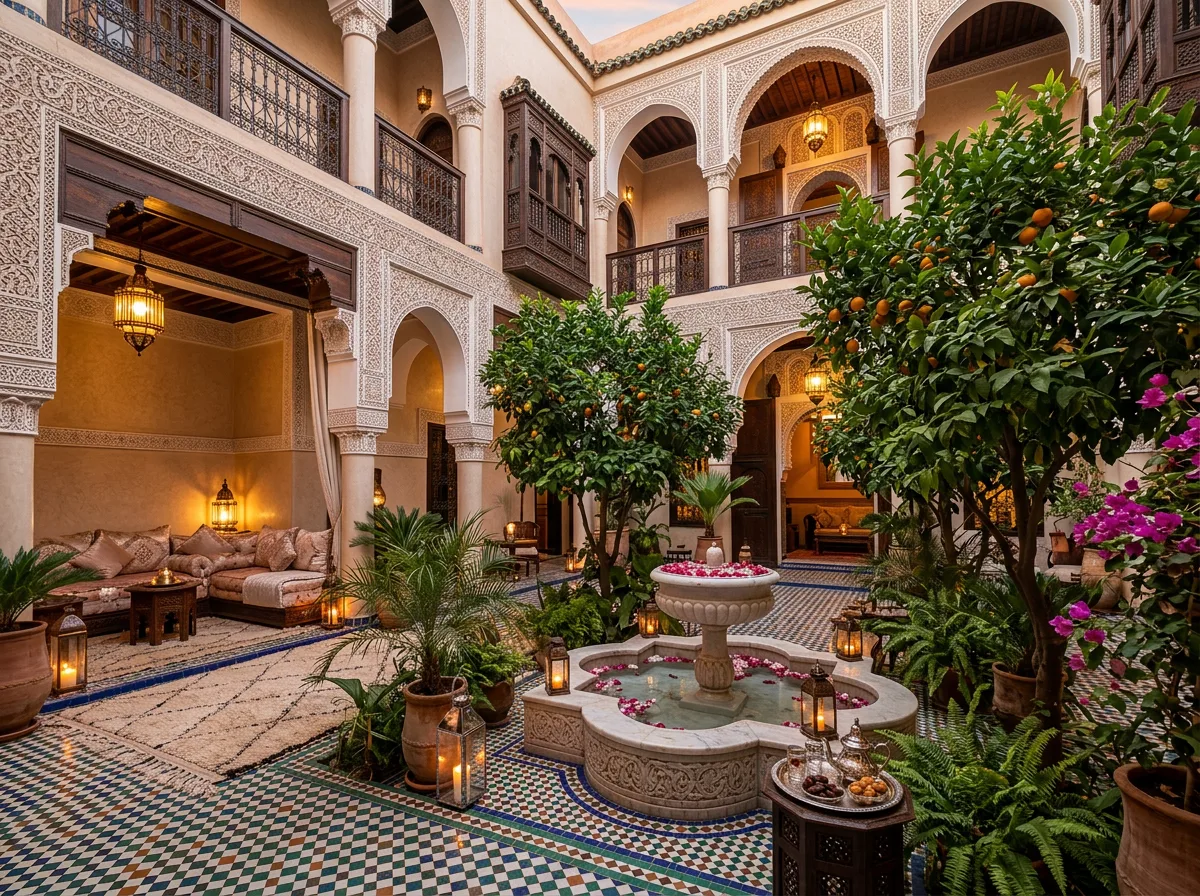
If you only have a few days and you are running day trips out of Marrakech, your riad is more than a bed — it is the calm base you leave at dawn and return to at dusk. The right one does early breakfast without fuss, holds your bag on a check-out-day excursion, and sits where a driver can reach you. But the word 'riad' now covers everything from a lovingly restored 17th-century merchant house to a newly built guesthouse that borrowed the look without the soul. Knowing what to look for saves money, time and a frustrating 7am.
What makes a riad a riad?
A true riad is a townhouse organised around an interior courtyard — the wast al-dar — typically featuring a central fountain or small pool, a garden of citrus and olive trees, and rooms or suites arranged on two or three storeys around the central void. Light falls from above; the street façade is plain plaster. Everything beautiful is hidden inside.
This inward architecture was deliberate: riads were private family homes where the courtyard provided air circulation, greenery and a social heart. Many of Marrakech's finest examples are 200–400 years old, built when the Saadian and Alaouite dynasties made Marrakech a royal city. The architectural details to look for — hand-cut zellige tilework, carved plaster (stucco), painted cedarwood ceilings (moucharabieh screens) — represent centuries of craft tradition.
Many modern 'riads' are newly built or are guesthouses that adopted the courtyard format without the historical fabric. They can be excellent, but they're a different experience. If staying in a genuinely old riad matters to you, ask the property directly about its history and look for thick walls, original tiling and hand-carved woodwork rather than smooth painted surfaces and imported tiles.
Which quarter is easiest for early excursion pickups?
All the best riads are in the medina, where cars cannot reach the door. Since most day trips leave Marrakech between 6:30 and 8am, the quarter you pick decides how long you walk to the waiting vehicle. The differences that matter:
- Mouassine & Bab Doukkala: the most characterful area, with the densest concentration of traditional riads, the Mouassine fountain and mosque, and easy proximity to the dyers' souk. Bab Doukkala is a working medina gate, so a driver can pull right up — a strong pick for early Ouzoud or Aït Ben Haddou starts.
- Riad Laarous & Kennaria: quieter and more residential, slightly further from Djemaa el-Fna but less tourist-trafficked. Excellent value and a calm courtyard to return to after a long Atlas day. Confirm the nearest point a vehicle can reach before you book.
- North medina (near Bab el-Khemis): furthest from the square but home to some of the city's finest restored riads, and sitting on the northern road out of town — convenient if your excursions head toward Ourika or the Ourika-side Atlas. Best for travellers who value calm over central bustle.
- Near Djemaa el-Fna: the most convenient for getting to and from the square, but also the noisiest — motorbikes, vendors and music carry into the night, which stings on a pre-dawn pickup morning. Check for a roof terrace as a retreat and a quieter room away from the lane.
What should you look for when you'll be out all day?
Beyond aesthetics, these are the questions that actually matter when the riad is a base for excursions rather than the whole holiday:
- Will they do early breakfast or a packed bite? On a 6:30am start for Ouzoud or Aït Ben Haddou you won't sit down to a full spread. An excursion-friendly riad will plate something early or pack bread, eggs and fruit for the road.
- Can they hold luggage on a check-out-day trip? Many people end a stay with one last excursion before a late flight. Confirm they will store bags and let you freshen up on return.
- Is it owner-managed or agent-managed? Owner-present riads tend to be more flexible around early starts, late returns and meeting your driver at a set point and time.
- Is there a plunge pool? In summer (June–August), coming back from a furnace-hot Agafay or desert day to a cool dip is not a luxury but a relief in Marrakech's 38–42°C heat.
- Are the bedrooms air-conditioned? Traditional riads stay naturally cool by design, but upper rooms can be warm in July and August — and you want real sleep before an early pickup. Confirm AC in the room, not just common areas.
- Where exactly will the driver meet you? Riads deep in the medina are car-free; a good property will name a precise gate or landmark and send a porter for your bags. Pin this down before your first excursion morning.
Where to book and how to avoid disappointment
Booking directly with the riad — by email or WhatsApp — often gets you a better rate than third-party platforms and gives you a direct line to the team before you arrive. It also lets you ask the questions above and judge the quality of response.
When reading reviews, weight those from travellers using the riad the way you will — as a base between trips. Look for comments about early breakfast, flexibility with luggage, how easy the driver pickup was, and noise levels for anyone needing pre-dawn sleep. Those reveal far more about a day-trip base than praise about the décor.
If you'd rather not piece it together yourself, our day-trip planners work with a handful of Marrakech riads across price points that we know firsthand. We match you to one that fits your dates and group, then build the excursions around it — Agafay, Ourika, Ouzoud, Essaouira — with every pickup point and time agreed in advance. See our Marrakech destination guide and private day-trip options for more.
Frequently asked
What exactly is a riad, and why does it make a good base for day trips?
A riad (from the Arabic 'riyadh', meaning garden) is a traditional Moroccan townhouse built around a central interior courtyard, often with a fountain, citrus trees and a plunge pool. For anyone running excursions out of Marrakech — Agafay one day, the Ourika Valley the next, Ouzoud after that — a small riad of 5 to 15 rooms is the ideal home base: a quiet courtyard to come back to each evening, staff who hold your bags on early-start mornings, and a kitchen that can do breakfast before your driver arrives. You leave at dawn, see the Atlas or the desert, and return to the same cool, calm courtyard at dusk.
Which neighbourhood is best if I'm using Marrakech as a day-trip base?
Stay in the medina, but think about how your driver will collect you. The Mouassine, Bab Doukkala, Riad Laarous and Kennaria quarters are all walkable to the souks and within 10–15 minutes of Djemaa el-Fna. For day excursions, a riad near a medina gate (Bab Doukkala, Bab Laksour) shortens the walk to where a vehicle can wait — useful when you have a 7am pickup for Ouzoud or Aït Ben Haddou. The Hivernage and Guéliz districts have hotels but no real riads, and the medina experience is the one worth coming back to between trips.
How do I find a good riad without relying on a famous name?
Look for riads that are owner-managed, with responses in a personal voice rather than corporate hotel-speak. Check the photos show the actual courtyard and rooms, not just decorative mood shots. If you plan to be out on excursions most days, ask directly whether they can do early breakfast, hold luggage on a check-out-day trip, and meet a driver at a set point and time. Reviews mentioning the host by name — and praising flexibility around early starts — are the strongest signal of a genuinely run riad.
Can a riad do breakfast before an early day-trip departure?
The good ones will, and it's worth confirming when you book. A proper Moroccan riad breakfast — msemen or beghrir (semolina pancakes), khobz (flatbread), argan oil and amlou (almond-argan paste), local honey, fresh orange juice, mint tea or coffee — is one of the great travel experiences, but on a 6:30am Ouzoud or Aït Ben Haddou start you may only have time for tea and bread to go. Ask whether they can plate something early, or pack a bite for the road. A riad used to excursion guests will not blink at the request.
Is it safe to come back to the medina after a long day excursion?
Completely. The medina is heavily policed and tourist-facing infrastructure (tourist police, CCTV, licensed guides) is well established. If you return after dark from a full-day trip, the alleys can be disorienting — just WhatsApp the riad and they will send someone to walk you in from the nearest gate. Arrange your airport transfer and your day-trip pickups through the riad or through us so you always know exactly where the vehicle waits.
How far in advance should I book a riad in Marrakech?
Good riads with 5–8 rooms book out months ahead for peak season (March–May and October–November) and over Christmas and New Year — the same windows when day-trip availability tightens, so lock both together. In shoulder or low season, two to four weeks' notice is usually enough. If you want a single calm base for a string of excursions rather than moving hotels, fix the riad first, then build the day trips around it.
Base + day trips, sorted together
A riad that fits your excursions, not just one with a free room.
Our day-trip planners know which riads do early breakfast, hold bags on a final excursion, and sit where a driver can reach you. Tell us your dates and the trips you want — Agafay, Ourika, Ouzoud — and we'll match the base and the pickups.
Request an itinerary